
Boosted Sterile Insect Technique (SIT)
a cost efficient next gen technology for mosquito control

MoSITouch WILL operate state-of-the-art SIT factories
We plan to operate our own highly-secure factories using the most advanced equipment for mass-rearing and irradiation as well as proprietary protocols to boost efficiency.

Mass production and release of highly efficient male mosquitoes
Mass-rearing and sterilisation of millions of male Aedes albopictus using internally developed techniques and protocols.
Proprietary method to boost the efficiency of sterile males through coating with larvicides leading to larvae suppression in the field.
field-proven results and strong public acceptation
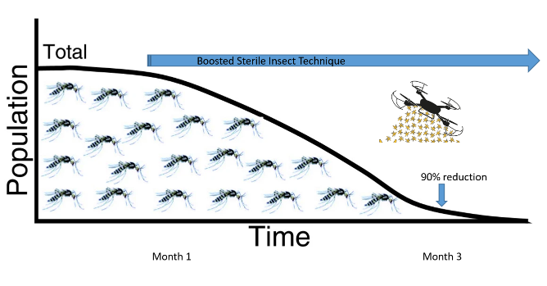
Our field-proven approach leads to a rapid reduction in wild mosquito populations and mosquito nuisance over large areas.
We service both institutional and corporate customers.
Boosted SIT is a novel technique to improve the efficiency of the decades-old Sterile Insect Technique (SIT). We mass produce and release highly competitive and harmless sterile male mosquitoes. Only female mosquitoes bite. Males do not bite as they do not lay eggs!
The male mosquitoes we release are not transgenic. Unlike other techniques they do not introduce new bacteria in our fragile environment.
Our mosquitoes carry regulatory-approved larvicides. They reduce adult population by preventing larval development in thousands of larval habitats for long lasting effects.
Our boosted SIT approach enables us to release half as often and 10x fewer mosquitoes than the traditional Sterile Insect Technique. It does not require a buffer zone and can be efficiently deployed on areas of 10ha to 10 000+ha. We apply optimal doses of our larvicide which are well below those recommended by WHO in drinking water.
Some of our partners...

Relevant publications...
Dupraz, M., Lancelot, R., Diouf, G., Malfacini, M., Marquereau, L., Gouagna, LC., Rossignol, M., Chandre, F., Baldet, T., Bouyer, J.
Comparison of the standard and boosted sterile insect techniques for the suppression of Aedes Albopictus populations under semi-field conditions| Parasite Vol. 32, 2025
Bouyer, J., Almenar Gil, D.,Pla Mora, I., Dalmau Sorli, V, Dupraz, M., Simard, F., Baldet, T., Lancelot, R.
Suppression of Aedes mosquito populations with the boosted sterile insect technique in tropical and Mediterranean urban areas. Scientific Reports 15
Bouyer, J., N. Culbert, A. H. Dicko, A. Klaptocz, J. Germann, T. Wallner, G. S. Herranz, R. Argiles Herrero, J. Virgilio, M. Gomez, H. Yamada, F. Balestrino, and M. Vreysen. Field performance of sterile male mosquitoes released from an uncrewed aerial vehicle. Science Robotics 5: eaba6251.
Douchet, L., M. Haramboure, T. Baldet, G. L’ambert, D. Damiens, L. C. Gouagna, J. Bouyer, P. Labbé, and A. Tran. Comparing sterile male releases and other methods for integrated control of the tiger mosquito in temperate and tropical climates. Scientific reports 11: 1-14.
Haramboure, M., P. Labbé, T. Baldet, D. Damiens, L. C. Gouagna, J. Bouyer, and A. Tran. Modelling the control of Aedes albopictus mosquitoes based on sterile males release techniques in a tropical environment. Ecol Model 424: 109002.
Pleydell, D. and J. Bouyer. Biopesticides improve efficiency of the sterile insect technique for controlling mosquito-driven dengue epidemics. Communications Biology 2019; 2: 201.
MoSITouch SAS
Tel. +262 693 39 33 31
info@mositouch.com
Spin-off CIRAD La Réunion


